[ MONTH IN CARS ] Events
Huge turnout and many iconic cars make for a spectacular NEC Classic Motor Show
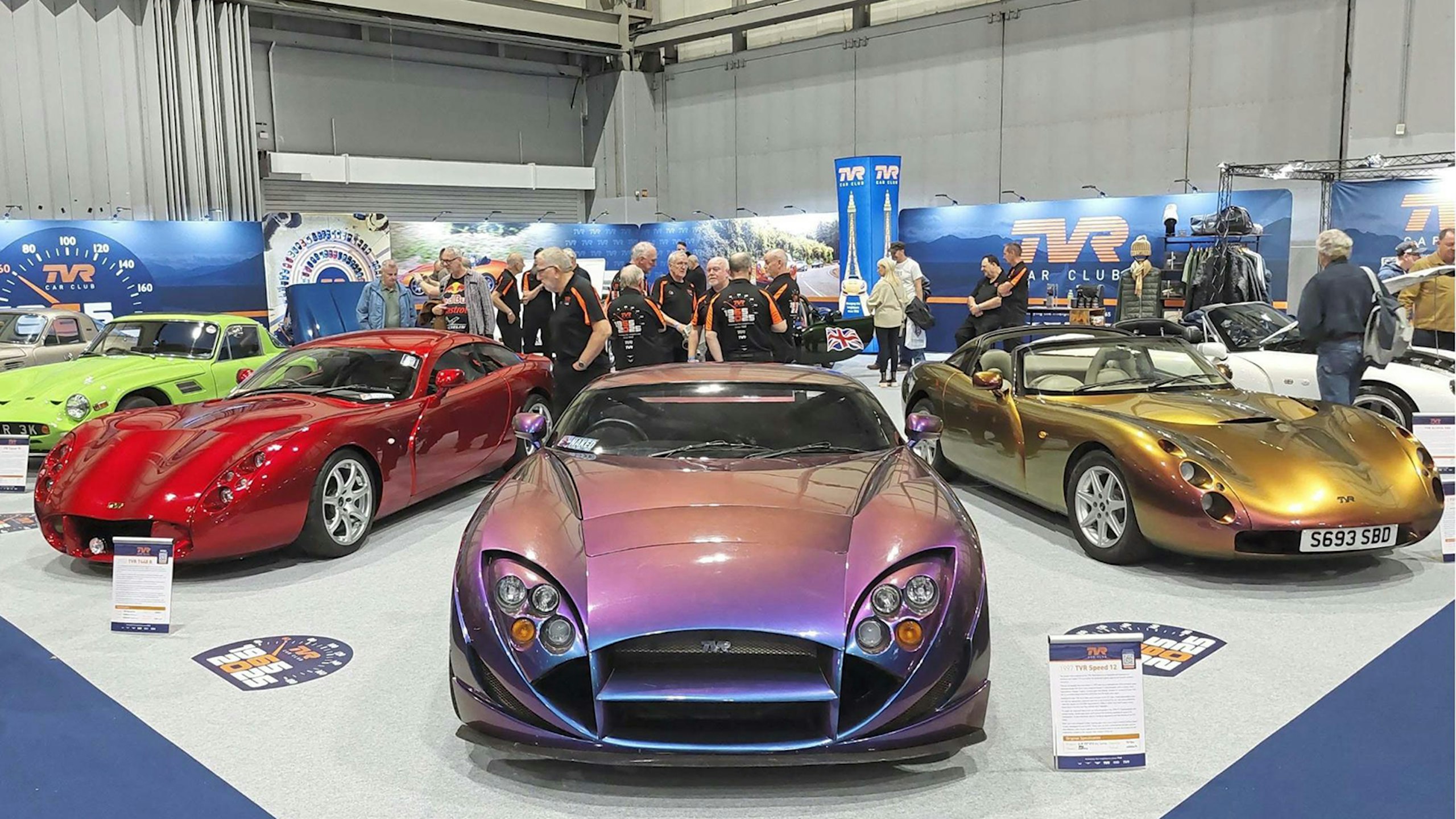
The NEC captured the essence of its glory days hosting the British Motor Show at this year’s Classic, with showstopping concept cars from TVR and MG seen for the first time since they were first unveiled. The Birmingham show was so popular that visitor traffic stretched as far away as two motorway junctions, and Practical Classics editor Danny Hopkins was inducted into the Classic Hall of Fame for services to the classic car community.
TVR Speed 12

‘This is the first time this car has been shown since it debuted at the NEC back in 1997,’ said restorer Clive Reed of TVR’s most famous and dramatic concept car. ‘After showing it, TVR built the Cerbera Speed 12 GT1 racer, and transplanted the Speed 12’s engine and gearbox into it. This car was registered, but it never hit the road.
‘Its odometer still only has 12 miles on it. It’s never even been outside. Rather than the TVR ‘graveyard’ in Blackpool, it ended up in the North East, in the back storeroom of a garage, covered in a sheet and assorted car parts.
‘Because the original engine is still in the racing car, I decided to build my own, based on a Jaguar V12 block and a pair of TVR Speed Six cylinder heads. The bores didn’t quite line up, so I gutted the block, took the liners out and machined new innards for it. It’s now a 7.2-litre, on Jenvey throttle bodies, fuel injection and a dry-sump oil system. It will go in – the engine bay’s massive – but there are no electrics at the moment. It’s not on the right wheels either – I need to build some with the right offset around modern tyres. Again, its original five-spokes ended up on the Cerbera Speed 12.
‘TVR boss Peter Wheeler said the car was just too wild for the road, even though Keith Flint of The Prodigy had given him a deposit for it. He also reasoned that £150,000 was just too expensive for a TVR. But under contemporary GT1 racing regulations, just one roadgoing car needed to be made in order to homologate the racer, and it made more sense to do this via the Cerbera than with an all-new model.
‘It had sat in that garage for 12 years before it was offered to me. I bought it, but then went to Singapore until 2019. I came back and started restoring it during the covid pandemic.’
Bugatti Type 57C Stelvio
This dramatic Gangloff-bodied Bugatti was on show for the first time, having arrived in the UK from the US for restoration in 2023. ‘It was sold new in 1938 by the Belgian Bugatti agent Alphonse Evrard & Houp of Liège, to a Mr. Zurstrassen,’ said Angela Hucke, curator of the Bugatti Trust. ‘After Zurstrassen, the car became the first Bugatti sold by Belgian dealer Jean de Dobbelaer – to Georges Bouriano, the racing driver who finished second at the first-ever Monaco Grand Prix, in 1929, driving a Bugatti Type 35C.’ Prior to Monaco, Bouriano contested the 1927 Spa 24 Hours in a Georges Irat with Ken Bartlett, finishing in tenth place.
‘Alden Sherman took it to the US in the Fifties, where it remained for more than six decades, before finally coming to the UK two years ago in need of a complete restoration.’
Lotus 11
Shown mid-restoration on the Historic Lotus Register stand, this 11 was originally built at Lotus’s Hornsey factory to break the 1100cc world speed record at Monza. It achieved 138mph on 3 September 1956 with Stirling Moss driving, returned to Hornsey for repairs, then returned to Monza with Herbert Mackay-Fraser behind the wheel, posting 143mph on 9 October. The record was broken, and in terms of the Monza circuit, the achievement still stands today.
Later owners carried out unsympathetic modifications, including the removal of its enclosed Perspex bubble canopy. But the car has been identified as the Monza record-breaker via its extra front chassis tubes, an emergency hatch release hole in the driver’s door, the remains of an air vent, flush-fitting Dzus fastener brackets, the repairs to the battery mounting carried out after the first run, dual throttle levers, and, amazingly, the spacing of its rivets.
The car is currently being restored to original Monza specification by D Type Developments for owner Bernd Reichert.
Renault 5 Turbo
Shown for the first time post-restoration, this Renault was 1994 World Rally Champion Didier Auriol’s first Group B rally car. ‘He drove it in the 1983 season of the French Rally Championship,’ said Zak Davis of H Engineering. ‘He won his class on the Rallye de la Baule and Rallye des Garrigues, then upgraded to the latest Tour de Corse model for 1984.
‘It was bought by a privateer, who repainted it blue with yellow accents. It was involved in a big shunt in the early Nineties, and left in storage until a customer of ours, who also owns a Lancia 037, discovered it and restored it. It was a major job, and the car needed a new roof! But as a Renault works car, it has a magnesium gearbox casing – the customer cars didn’t have that.’
Tornado Fiat-Lotus 600
‘This car has been in storage for years after being restored by Middle Barton Garage back in 2008,’ said Andreas Hicks of dealer Klasikó. ‘It was built in 1966 by Tornado – better known for its Typhoon sports car – for competition, initially with a Ford Cortina 1500GT engine.
‘Then the owner David Render, a friend of Colin Chapman, arranged for a Lotus Twin Cam engine, supplied via Chapman himself. Render drove it at hillclimbs and sprints, where it outperformed Ferraris, E-types and Allards, winning more than 80 trophies.
‘Tony Castle-Miller of Middle Barton Garage bought it in 1972, racing it in Special Saloons for the rest of the decade, before putting it into storage. Although he restored it, he unfortunately never took it out again.’
Bentley T1 MPW Coupé
On show for the first time, this Bentley has a significant ownership history. ‘It’s a 1966 car, predating the Corniche, built by Mulliner Park Ward,’ said Dan Brooks of Cult Commercials, where the car is for sale. ‘It was ordered new by Max Rayne, and is currently owned by Paul Hembery, Pirelli’s F1 boss.
Lord Max Rayne was a property tycoon and philanthropist who took charge of the National Theatre in 1971, overseeing its relocation to the South Bank and installing Peter Hall as director. He founded London Merchant Securities, putting much of the proceeds of that into the arts, academia and medical research.
‘In 1978 he sold the Bentley to Lt Donald LeStrange Campbell, MC, of the 81st Welsh Field Royal Artillery.’ Hembery, who bought the car from a specialist who acquired it from Campbell, oversees all of Pirelli’s motorsport activities, across the World Rally Championship, sports prototype racing, and Formula One.
Subscribe to Classic Cars today. Choose a Print+ Subscription and you'll get instant digital access and so much more. PLUS FREE UK delivery.