[ MONTH IN CARS ] Events
Lotus and Alfa Romeo figure strongly in epic 2025 meeting

Long-unraced cars from Lotus, the legacy of Jim Clark, and some of the most historied competition Alfa Romeos defined the 2025 Goodwood Revival meeting. On the track, drivers battled deluges of rain, which created tricky driving conditions and handed unexpected advantages to nimble cars.
Lotus-Ferrari 19
‘It’s the first time that this car has raced in the UK in this configuration,’ said Jakob Holstein of his unusual racer, possibly the only Ferrari-engined Lotus in existence, especially given the animosity between Enzo Ferrari and Colin Chapman.
‘It began life in 1960 as a conventional Lotus 19, with a four-cylinder engine, built for the UDT Laystall racing team,’ said Holstein. ‘However, in 1963 it was bought by Tom Connor in the US, whose equipe, Team Rosebud Racing, campaigned Ferraris. Connor fitted the 19 with a Ferrari V12 from a 250 Testa Rossa.’
The car would prove to be a handful to drive. ‘Innes Ireland crashed it at Riverside in 1963,’ said Holstein. ‘Connor rebuilt it after this and continued to race it into 1964, but then donated it to a local school – Victoria High – as part of a tax rebate, hence the lettering that’s displayed on the side. The students at the school used it to learn about car maintenance.
‘Years later, it was re-imported to the UK and restored to its original spec as the Laystall car. This was how I bought it, but I crashed it, necessitating a rebuild. During the research, I tracked down the guy who owned it in the Eighties, who still had Connor’s bodywork and engine, so I decided to reunite them with the car.’
Lotus Type 35
‘It’s the first time that this car has been seen in over 50 years,’ said Clive Chapman, son of Colin Chapman and director of Classic Team Lotus, of this Formula Two car originally driven by Jim Clark. ‘It was a modified Type 32; Dad’s idea was to create one chassis which could accommodate several different power units and be competitive across all Formulae. This was an F2 car – with the works Lotus F2 team looked after by Ron Harris – fitted with a 117bhp one-litre Cosworth SCA engine.
‘This is chassis 35-F-3, driven by Clark alongside Mike Spence and Peter Revson in a three-car team. Clark won five races of the 1965 F2 season.’ It was sufficient for Clark to secure the 1965 European F2 Championship – in the same year, Clark also won the F1 World Championship, the Tasman Series, and the Indianapolis 500.
‘The regulations changed not long after, the car was never used again and in 1970 a private collector bought it from Harris. It’s been in storage one way or another, original and unrestored, since Jimmy last got out of it over 50 years ago. It’s a non-runner – it was last fired up the day the collector bought it.’
Aurora-BMC
‘This car hasn’t been seen since it was locked away in the Seventies,’ said Dr Marc Geach of his unique sports-racer. ‘It was supposed to be a prototype for a new road car, built by racing driver Trevor Taylor in a garage in Rotherham.
‘The entire Taylor family was involved in it,’ said Geach. ‘Trevor’s brother Mike, who worked in Formula Junior, designed the chassis, his other brother David, an artist, penned the bodywork, which was built by Williams & Pritchard, and Trevor and his sister Anita would drive it.
‘The intention was to offer it at as low a price as possible, so it used several standard Mini Cooper S parts, including the wheels, steering rack, and entire engine and gearbox assembly, unchanged but relocated to the centre of the car. In comparison, the suspension was very advanced though, with inboard roller-rockers, although it also uses Mini cones.
‘Trevor announced the car and tested it at Oulton Park. Anita raced it at Mallory. But then Bob Anderson raced it in the Lavant Cup here in 1966. He was up against Lola T70s, Lotus 30s and Elva-BMWs driven by the likes of Roy Salvadori, Bruce McLaren, John Surtees, Denny Hulme and Graham Hill. It was a really, really wet race, and Anderson finished fourth, with just 1150cc.
‘I don’t know why the Taylors didn’t make more of them, but Trevor was too busy driving, and sold the car to John Wales. We’ve borrowed an engine from Nick Swift to get it going again, and we’re praying for rain to see if it can perform the giant-killing feat once more.’ The weather delivered, but sadly it resulted in a spin-off for Swift.
OSCA-Fiat
Racing in the UK for the first time, this Formula Junior was another example of two usually-unconnected badges on the same car, in this case the Maserati brothers-founded OSCA and the prancing horse of Ferrari. ‘It was run by Luigi Chinetti’s North American Racing Team – NART – Ferrari’s official US importer and favoured sports-racing privateer,’ said Peter Leahey of Auriana. ‘In truth, I don’t think Chinetti cared what Ferrari thought of him running OSCAs in Formula Junior, but he did so in order to support Denise McCluggage, who was a journalist as well as a racing driver, and who brought much-needed publicity to the team. The Rodriguez brothers drove for NART at the time too.
‘McCluggage drove the car at Watkins Glen, then Ricardo Rodriguez competed in it in the Vandervell Cup. When we bought it, we identified it partly through a photo of McCluggage with the car in a support race for the 1960 Sebring 12 Hours, which showed the side-vents to be welded shut – we found the exact same welds. After McCluggage’s time with it, the car was raced in the US in the Seventies by Bob Sutherland, who later founded the Colorado Grand road-rally.’
Alfa Romeo TZ
‘It hasn’t raced since we restored it ten years ago so this is its first time at Goodwood,’ said Carl Ahlqvist of his father’s 1964 Alfa Romeo TZ.
‘It’s one of four Scuderia Sant Ambroeus team cars driven at Le Mans 1964, this one by Jean Rolland and Fernand Masoero, there were two red, two green cars. Ours crashed out on lap 47.’ Cars 57 and 41 came home an impressive first and second in the GT 1.6 class.
According to Ahlqvist, chassis 750003 also entered the Tour de France, Tour de Corse and Critérium Cèvennes. ‘It was fast but not very reliable and by 1965 the TZ was outdated, and was replaced by the TZ2.’
Carl says his father Magnus bought it 15-20 years ago in the Netherlands. ‘The team cars had a different nose treatment, knock-off wheel spinners and an outside fuel filler, but by then it had been converted to use as a road car, fitted with fixed windows and bolt-on wheels, and it had been painted red.
‘The dry sump engine is tilted over to help lower it in the chassis and is has a special twin-spark cylinder head. Things like the thin tubular chassis and aluminium body made restoration challenging.’
Lotus Elan 26R
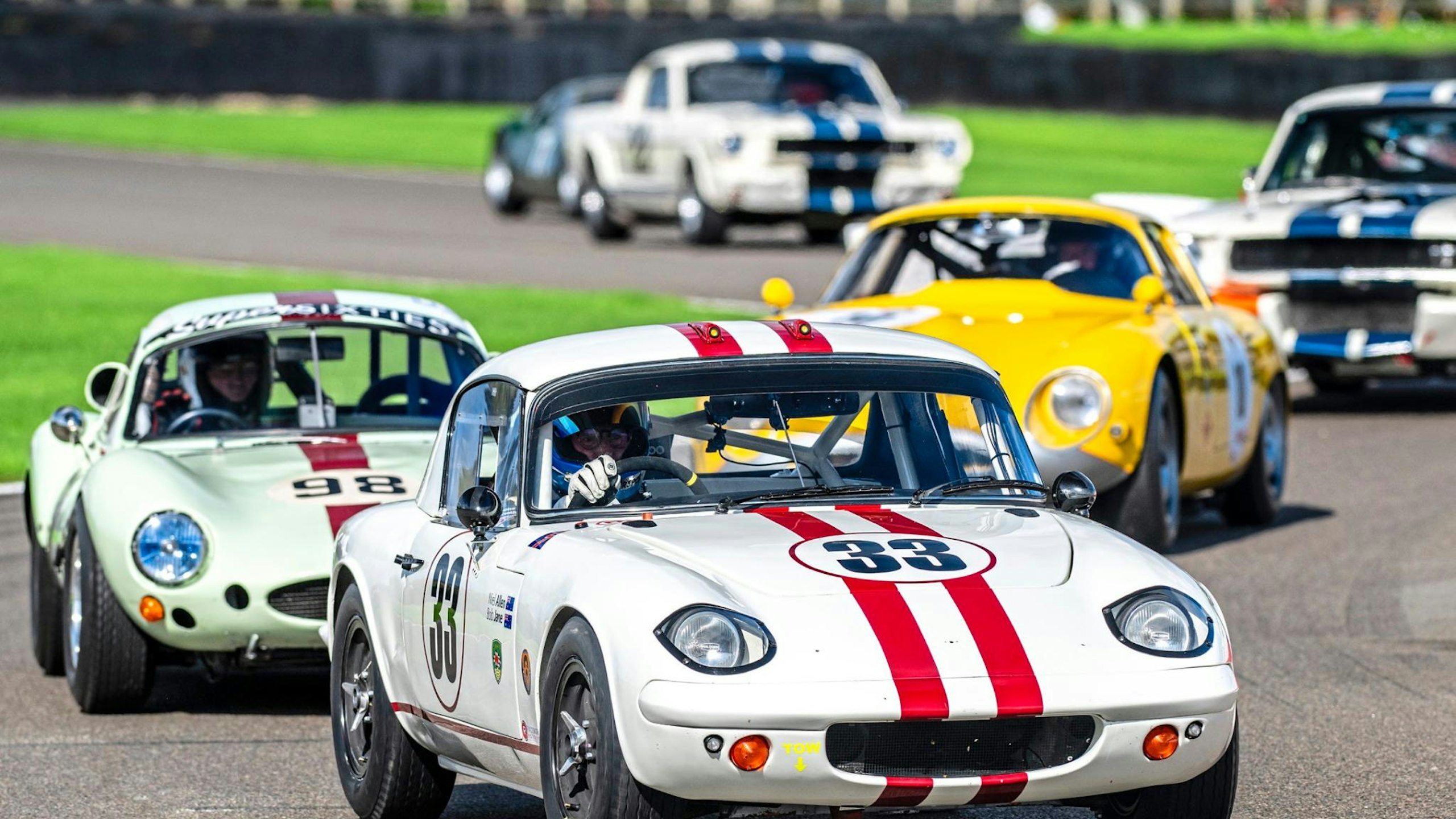
This Lotus, competing at Goodwood for the first time, was originally campaigned by two greats of Australian motorsport. ‘It was bought new by Bob Jane in 1965, but although he owned it, it was mainly driven by Niel Allen, who scored several wins with it in the Australian GT Championship including three at Warwick Farm and one at Oran Park,’ said owner Andrew Lawley. ‘He also finished fifth at Bathurst.
‘Allen was a wealthy young property developer who competed in the Tasman Series. His main claim to fame was setting the lap record at Bathurst in a McLaren M10B in 1970, a record which stood until the circuit was reprofiled in 1987. But he retired in 1971 to concentrate on his business and never raced again.’
Bob Jane won four Australian Touring Car Championships, the 1963 Australian GT Championship, and four Bathurst 500s.
Alpine A110
‘It’s the first time this car, the most original works rally A110, has ever been shown outside of France,’ said owner Nigel Dodsworth of his Alpine, centrepiece of a display by the marque in the Revival’s indoor Motor Show.
‘It was one of 15 team cars built for the inaugural World Rally Championship in 1973, which Alpine won,’ said Dodsworth. ‘This one is a heavy-body, rough-road car built for the Rallye Maroc, where it was driven by Jean-Luc Therier in 1973. Therier finished seventh on its first outing, but broke the suspension, after which it went back to the Alpine factory in Dieppe to be upgraded with both wider wheelarches and a stronger front suspension set-up.
‘After this, it went to the US, where Marianne Hopfner drove it on the 1974 Press On Regardless Rally in Michigan, finishing ninth, before the car was reimported back to France.
‘Then it was run by ex-dentist Bob Neyret’s Aseptogyl rally team; Christine Dacremont finishing third on the Manx Rally and contesting the Acropolis the following year.
‘In 1976 Jean-Claude Andruet was driving for Alfa Romeo, but managed to use this car for two rallies through his sponsor Yves Jouanny, including the Maroc. He admitted that showboating in the lead resulted in dust in the engine, dropping him down to second place. Next, it was driven by Jean-Pierre Jaussaud on the 24 Hours of Chamonix ice-race. Snow came through the floor of the car and it finished ninth. Later that year, Jaussaud won Le Mans with Didier Pironi in an Alpine A442B.
‘It’s been modified over the years, but it’s never been restored. It’s probably the only works A110 still with its original windscreen.’
Porsche 910
The culmination of a long-term restoration project, this Porsche was racing at Goodwood for the very first time. ‘Dad’s collected Porsche memorabilia for years, but 15 years ago, he acquired an original 910 chassis, originally a spare kept aside by a French racing team in 1966,’ said Nick Morfett of his father Kevin.
‘In the ensuing years, he scoured the globe to track down as many original parts as possible in order to finish it, and around five years ago, we started to finally pull them all together.
‘Franck Reynard, a French engineer who built racing Porsche 910s in period, restored the car’s bodywork, and then we had to fabricate our own wheels and rear suspension uprights because we just couldn’t find any genuine items, but everything else comes from genuine period competition 910s.
‘Sadly Porsche didn’t keep chassis records at the time, so we don’t know what racing campaign the chassis was assigned to. The mentality was always “on to the next race” and often these cars ended up crashed, ending up as combinations of 906 and 910, often converted into Spyders, especially in the US.’
Subscribe to Classic Cars today. Choose a Print+ Subscription and you'll get instant digital access and so much more. PLUS FREE UK delivery.